Law Firm Website Design: 15 Elements Every Attorney Site Needs
Here’s a hard truth most attorneys don’t want to hear:
Potential clients judge your legal competence by how your website looks before they ever read a word you’ve written. Research consistently shows people spend fewer than 8 seconds deciding whether to stay or leave a professional services website.
For law firms, where trust is literally the product, those 8 seconds can be the difference between a new client and a lost case.
Having designed websites for over 700+ professional clients, including financial services companies and regulated businesses that face the exact same trust challenges law firms do, I’ve identified the 15 elements that separate legal websites that generate clients from those that just take up digital space.
Working in financial services? Many of these principles apply directly to your sector too. See how we approach design for regulated industries. Learn more!
By the Numbers74%
of people judge a firm's credibility by its website design
57%
of users won't recommend a business with a poor mobile site
3s
average time before a visitor abandons a slow legal website
Start, scale & systemise your web design agency.
I bootstrapped my agency from zero to seven figures. The Margin is the operating system I wish I'd had.
Join The Margin


Need an expert to build your Squarespace website?
Book a free kick-off call with our team to discuss your project requirements in detail.
Why E-E-A-T Is Non-Negotiable for Law Firm Websites
Google classifies legal websites as “Your Money or Your Life” (YMYL) content, meaning it applies its strictest quality standards. E-E-A-T isn’t just an SEO acronym; it’s the framework Google uses to decide whether your firm deserves to be found online.
E
Experience
Real-world cases handled, client outcomes, years in practice
E
Expertise
Credentials, bar admission, practice area depth, authored content
A
Authoritativeness
Press mentions, speaking engagements, peer recognition, backlinks
T
Trustworthiness
SSL security, verified reviews, transparent pricing, privacy policy
AI VISIBILITY NOTEAI search engines like ChatGPT, Perplexity, and Google’s AI Overviews are now the first stop for many prospective clients.
These tools scan your site for structured, authoritative, clearly attributed content. A law firm website without proper schema markup, author bios, and FAQ sections is effectively invisible to the AI layer of search — even if it ranks on page one of traditional Google results.
The 15 Essential Elements
Trust & Credibility01: Professional Attorney Bios With Verified Credentials

Your bio page is where E-E-A-T is won or lost. Each attorney profile must include: bar admission details and year, law school and degrees, practice areas with case type specificity, professional associations, notable cases or outcomes (where ethically permissible), a professional photo, and direct contact information.
Generic bios that say “John Smith is a dedicated attorney with years of experience” are invisible to Google’s quality raters. Be specific: “Admitted to the California State Bar in 2009, specialising in complex commercial litigation with 40+ trials completed.”
Sam's Tip: Wrap attorney bios with Person schema markup so AI systems can correctly attribute expertise to named individuals at your firm.
02: Verified Client Testimonials and Case Results

Testimonials must be verifiable and specific to carry weight with both Google and prospective clients. Vague praise is dismissed by sophisticated users. Effective testimonials name the practice area, describe the outcome, and include the client’s first name and city at minimum.
Case results, where bar rules allow disclosure, are particularly powerful. “Secured a $2.4M settlement for a client injured in a commercial vehicle accident (Riverside County, 2024)” tells a story no testimonial can match.
Sam's Tip: Mark up reviews with Review schema so Google can display star ratings in search results, increasing your click-through rate by up to 35%.
03: Awards, Recognition, and Third-Party Validation
Martindale-Hubbell ratings, Super Lawyers selection, Avvo ratings, peer review recognition, and bar association leadership roles all serve as authoritativeness signals. Display these prominently, not buried in a footer, and link to the awarding organisation so Google can verify the relationship.
News mentions, podcast appearances, and published articles in legal journals function as editorial backlinks that carry significant authority weight. A dedicated “In the Media” section builds this signal systematically over time.
Conversion & User Experience04: Frictionless Consultation Booking

Every page on your site should have one clear, unmissable next step: book a consultation. For most law firms, this means a sticky header CTA, a mid-page embedded scheduling form (Acuity or Calendly), and a bottom-of-page reinforcement. Three placements, one goal.
Critically, the form itself must be minimal. Ask for name, phone number, email, and brief matter description only. Every additional field reduces completion rates. You can gather full intake details after the consultation is booked — not before.
Sam's Tip: Acuity Scheduling integrates natively with Squarespace and allows you to set consultation types, durations, and availability rules without any custom code. We set this up as part of every law firm build.
05: Practice Area Pages That Actually Explain Your Work
Most law firm sites commit the same error: listing practice areas without explaining what the legal process actually involves for a client. Someone searching “what happens after I’m served divorce papers” wants answers — and the firm that provides them earns the trust, the call, and eventually the case.
Each practice area needs its own dedicated page with: what the area covers, common client scenarios, how your process works, typical timeline, fee structure overview, and a specific CTA. This structure serves users and provides the depth that both Google and AI systems reward.
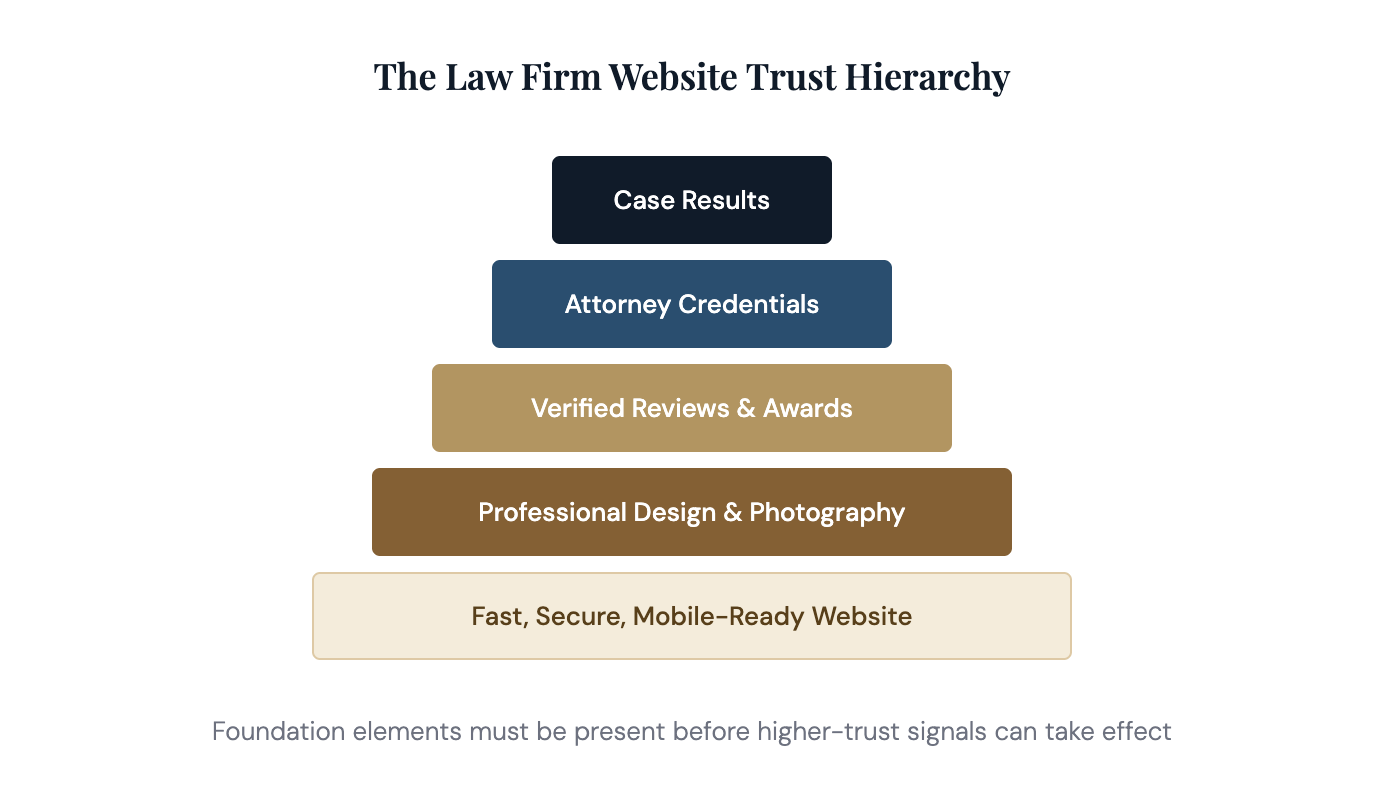
06: Mobile-First Design (Not Just Mobile-Friendly)
Over 65% of legal searches now happen on mobile devices. “Mobile-friendly” is the baseline that was acceptable in 2018. In 2026, your law firm website must be designed mobile-first: tap targets at least 48px, readable text without zooming, click-to-call phone numbers, and contact forms that work flawlessly on a 390px screen.
Google’s mobile-first indexing means the mobile version of your site is what Google actually ranks — not the desktop version. A beautiful desktop site with a clunky mobile experience will underperform in search regardless of how good the content is.
SEO & Technical Performance07: Location-Specific Landing Pages

If your firm serves multiple cities or counties, each location deserves its own dedicated page. A properly structured location page includes: local attorney information, office address or service area specifics, locally relevant case examples, embedded Google Maps, and content that reflects the legal landscape of that jurisdiction.
This structure is how smaller firms compete with large national practices in local search results. A targeted page for “divorce attorney Phoenix AZ” can outrank a national firm’s generic listing every time, provided the content genuinely serves local intent.
08: Schema Markup for Legal Organisations
Structured data is what allows AI systems and search engines to understand your firm beyond just reading text. Law firms should implement: LegalService schema, LocalBusiness schema with opening hours and address, Person schema for each attorney, Review schema for testimonials, and FAQPage schema for common legal questions.
This markup is invisible to visitors but critical for AI Overviews, Google’s rich results, and the citation systems used by AI search tools. Firms with proper schema appear in AI-generated answers; those without it are structurally excluded.
AI visibility tip: FAQPage schema on legal Q&A content dramatically increases the likelihood of being cited in AI search responses — the new frontier of legal client acquisition.
09: A Legal Blog That Demonstrates Expertise Over Time
Content is how law firms build E-E-A-T at scale. A blog that genuinely answers prospective client questions — “What’s the statute of limitations for personal injury in Texas?” or “What does a trustee actually do?” — positions your attorneys as the subject matter experts they already are.
Each post must be attributed to a named attorney, include publication and update dates, cover a specific question comprehensively, and link internally to relevant practice area pages. Content that builds over time creates a compounding SEO and authority effect that no paid advertising campaign can replicate.
"Your law firm’s website isn’t a digital business card. It’s the 24/7 intake coordinator that either earns the consultation — or hands it to your competitor."
— Sam Crawford, Squarespace Web Design Expert | 700+ sites launched
10: SSL Security and Comprehensive Privacy Policies
A law firm website without HTTPS is a trust disaster. Google flags non-SSL sites as “Not Secure” in Chrome, and prospective clients who see that warning — especially on a site where they may share sensitive legal matters — will leave instantly.
Additionally, a comprehensive privacy policy and cookie consent mechanism are legal requirements in many jurisdictions (GDPR, CCPA) and are E-E-A-T trust signals. The irony of a law firm failing to comply with data privacy law on its own website is not lost on sophisticated clients.
AI Visibility & Modern Discovery11: FAQ Sections on Every Key Page
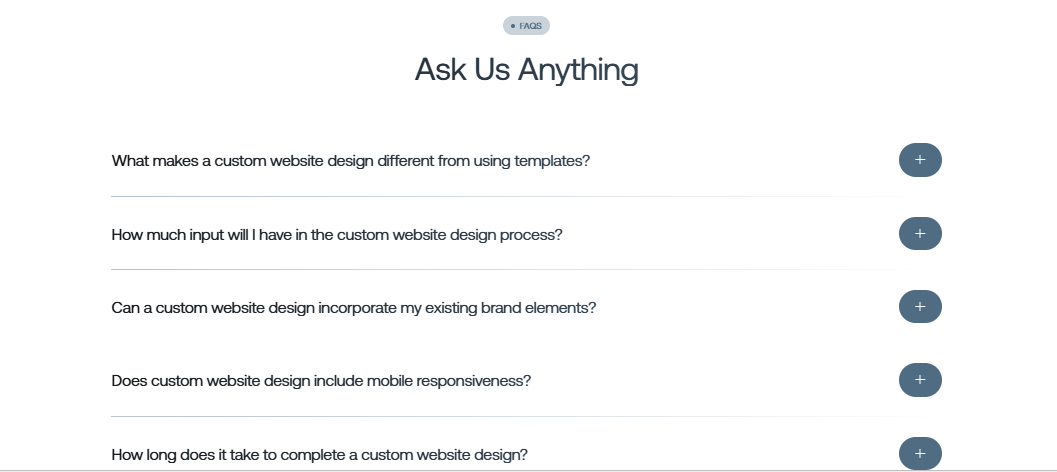
AI search systems are fundamentally question-answering machines. They scan the web for pages that explicitly answer questions, then cite those pages in responses. A law firm that structures its practice area pages with clear Q&A sections — marked up with FAQPage schema — is systematically positioning itself to be cited in AI-generated legal guidance.
Think about the questions prospective clients ask: “How long does a personal injury case take?”, “What’s the difference between Chapter 7 and Chapter 13 bankruptcy?”, “Can I still file a claim if the accident was partly my fault?” These answers should be on your site, attributed to named attorneys.
12: Transparent Contact Information and Business Verification
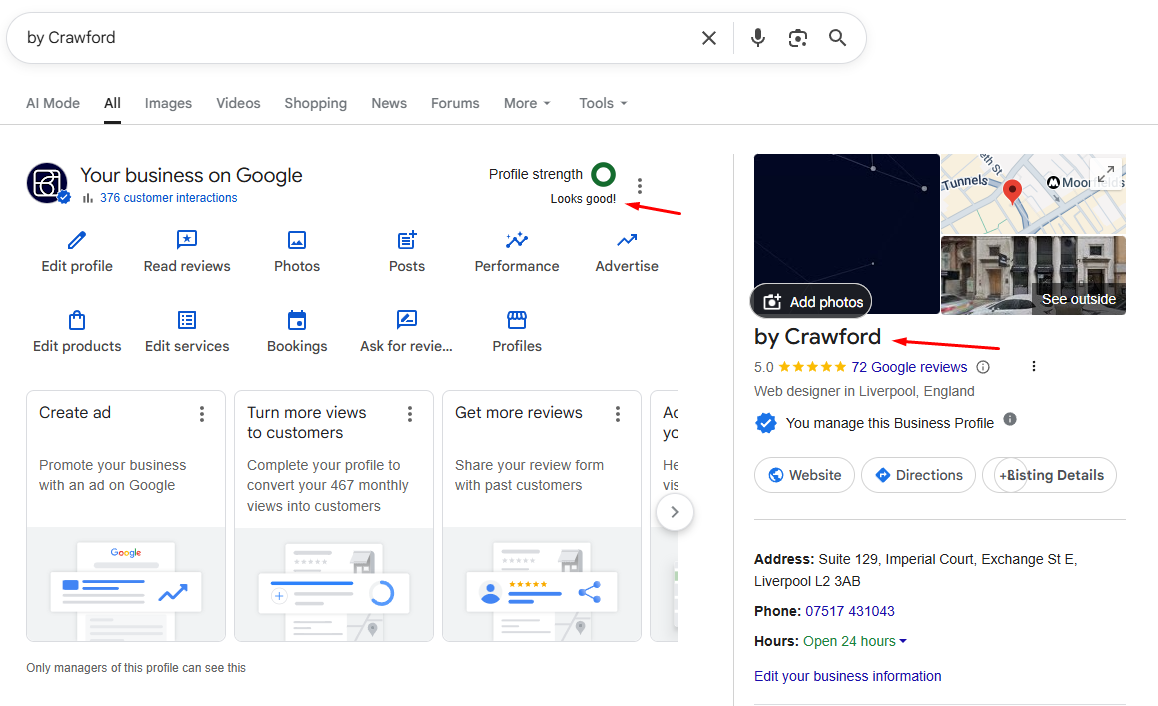
AI systems and Google cross-reference firm details against directory sources: Google Business Profile, Avvo, Martindale, FindLaw, and state bar directories. Consistent NAP data (Name, Address, Phone number) across all these sources is a foundational trust signal.
Your website must display: full firm name exactly as registered, physical address, local phone number, business hours, and email address. These details should appear in your footer on every page and on a dedicated contact page.
Design & Professional Presentation13: Professional Photography, Not Stock Images
Stock photos of anonymous people shaking hands in suits are the fastest way to signal inauthenticity on a law firm website. Prospective clients considering trusting you with their most sensitive legal matters want to see the actual human beings they’ll be working with.
Investment in professional headshots and office photography pays dividends across every page of your site. Authentic imagery is one of the clearest signals of genuine experience that Google’s quality raters look for in their E-E-A-T evaluation.
14: Clear, Jargon-Free Messaging
Legal websites consistently make the mistake of writing for other lawyers rather than for distressed people who need help. Someone whose spouse just filed for divorce, whose business partner is suing them, or who was injured in an accident does not want to read about “comprehensive legal representation in matters of family dissolution and asset division proceedings.”
They want to know you understand their problem, you’ve solved it before, and they should call you. Write for the human first. Complexity is demonstrated through expertise in content — not through impenetrable language in your headline.
15: Fast Core Web Vitals Scores
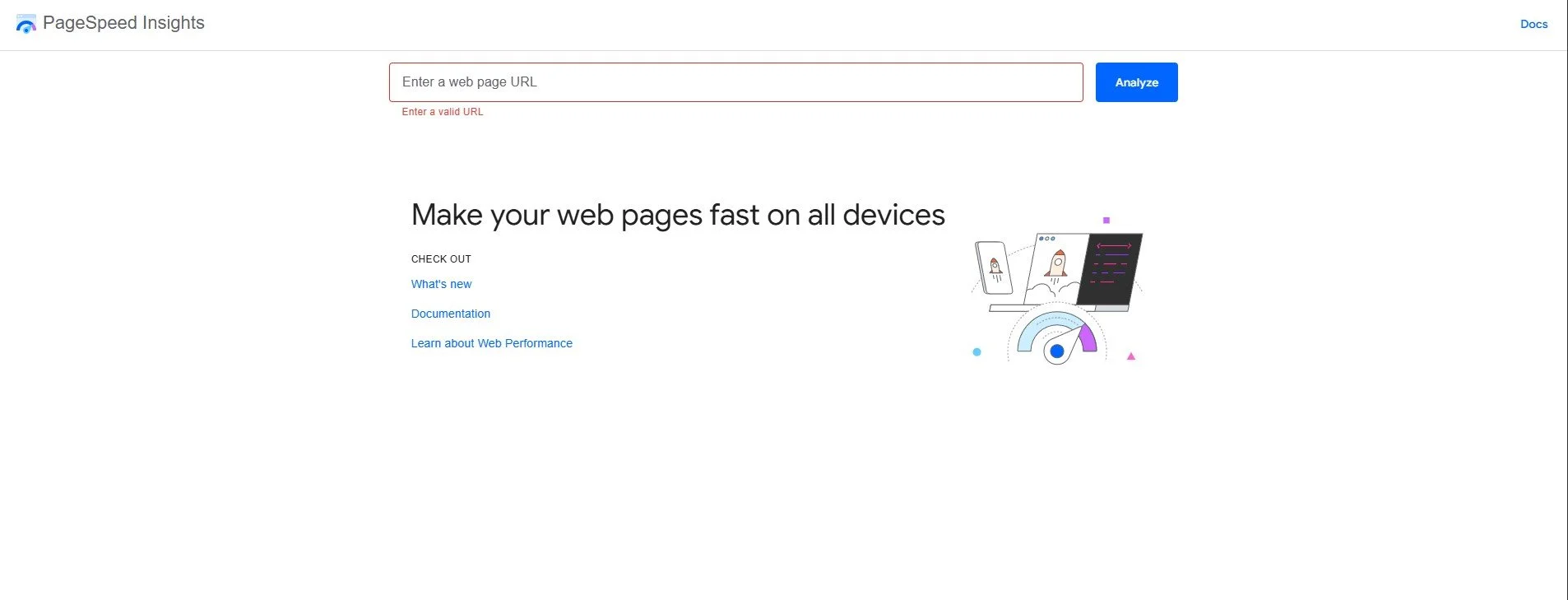
Google’s Core Web Vitals (Largest Contentful Paint, Interaction to Next Paint, and Cumulative Layout Shift) are ranking factors. A law firm site that loads in under 2 seconds will outperform an identical site that loads in 4+ seconds — all else being equal.
On Squarespace, Core Web Vitals performance is largely determined by image optimisation, third-party script loading, and template selection. Sites built following best practices routinely achieve 90+ performance scores on Google PageSpeed Insights — the benchmark for competitive legal markets.
Squarespace advantage: Squarespace 7.1 automatically serves WebP images, uses a global CDN, and lazy-loads images — providing a strong foundation for Core Web Vitals without custom configuration.
Frequently Asked Questions
What should a law firm website include?
A law firm website needs clear practice area pages, attorney bios with verified credentials, client testimonials, visible contact information, a mobile-first design, fast load speeds, SSL security, local SEO optimisation, schema markup, and prominent calls to action like “Book a Free Consultation.” The 15 elements in this guide cover everything a competitive legal site requires.
How much does law firm website design cost?
Law firm website design typically costs between $3,000 and $15,000 depending on the number of pages, custom features, photography, and the designer’s expertise. Ongoing SEO content and maintenance adds $300–$1,500/month for firms in competitive markets. Learn more about package details.
What is E-E-A-T and why does it matter for law firm websites?
E-E-A-T stands for Experience, Expertise, Authoritativeness, and Trustworthiness — the framework Google uses to evaluate quality in “Your Money or Your Life” categories like legal services. Law firm sites must demonstrate real attorney credentials, verifiable case outcomes, third-party recognition, and consistent trust signals to rank well.
How do I make my law firm website appear in AI search results?
To appear in AI Overviews, ChatGPT responses, and Perplexity citations, your law firm website needs: FAQPage schema markup on Q&A content, Person schema on attorney profiles, clear attribution of all content to named experts, consistent NAP data matching directory sources, and substantive answers to questions prospective clients actually ask.
Is Squarespace good for law firm websites?
Yes, Squarespace is an excellent platform for law firm websites when configured correctly. It delivers strong Core Web Vitals performance through automatic image optimisation and CDN delivery, integrates natively with Acuity Scheduling for consultation booking, supports custom schema markup injection, and provides SSL by default.
Designing for financial companies? The trust architecture required for law firm websites maps almost exactly onto what financial services firms need. See our dedicated approach!